Interactive Media · 2023–2024
Resonance
共·鸣
An Interactive Musical-Ritual Environment
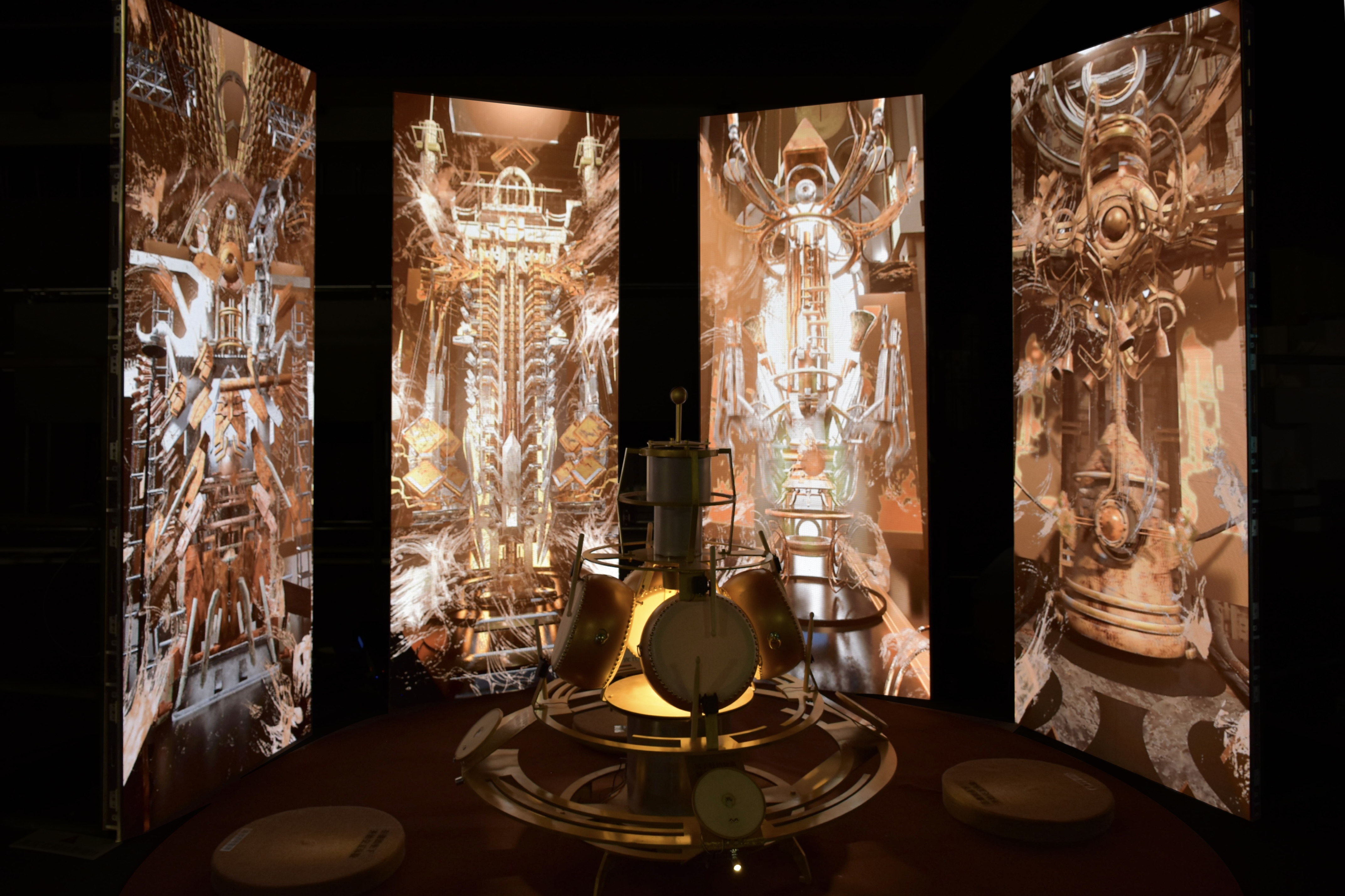
An interactive musical-ritual installation that translates Interaction Ritual Chain theory into spatial, audiovisual, and kinetic feedback, evaluated across three public exhibitions.
01 / Project Overview
Project overview
Resonance is an interactive musical-ritual installation that explores how co-presence and collective affect can be reconstructed in digitally mediated environments. A central frame-drum apparatus, four surrounding screens, robotic mallets, seat and strike sensors, and live camera mapping create a low-latency audiovisual call-and-response. Visitors move from spectators to co-performers as rhythm, image, light, and mechanical movement converge around shared attention.
02 / Project significance
Rebuilding ritual presence in digital space
Resonance begins with a central question: when interaction is no longer organized around bodily co-presence, how can ritual recover affective weight and symbolic intensity in the “weightless” digital sphere?
Rather than treating ritual as a visual theme, the project translates its social mechanisms into repeatable spatial and interaction principles: establish a legible center and boundary; use low-latency rhythmic feedback to support synchrony; anchor memory through a small set of strong symbols and replayable traces; and make participants mutually visible so they can move from spectators to co-performers. Developed through practice and examined across multiple public settings, these principles position the work as both an installation and a testable design method.
03 / Theory translation
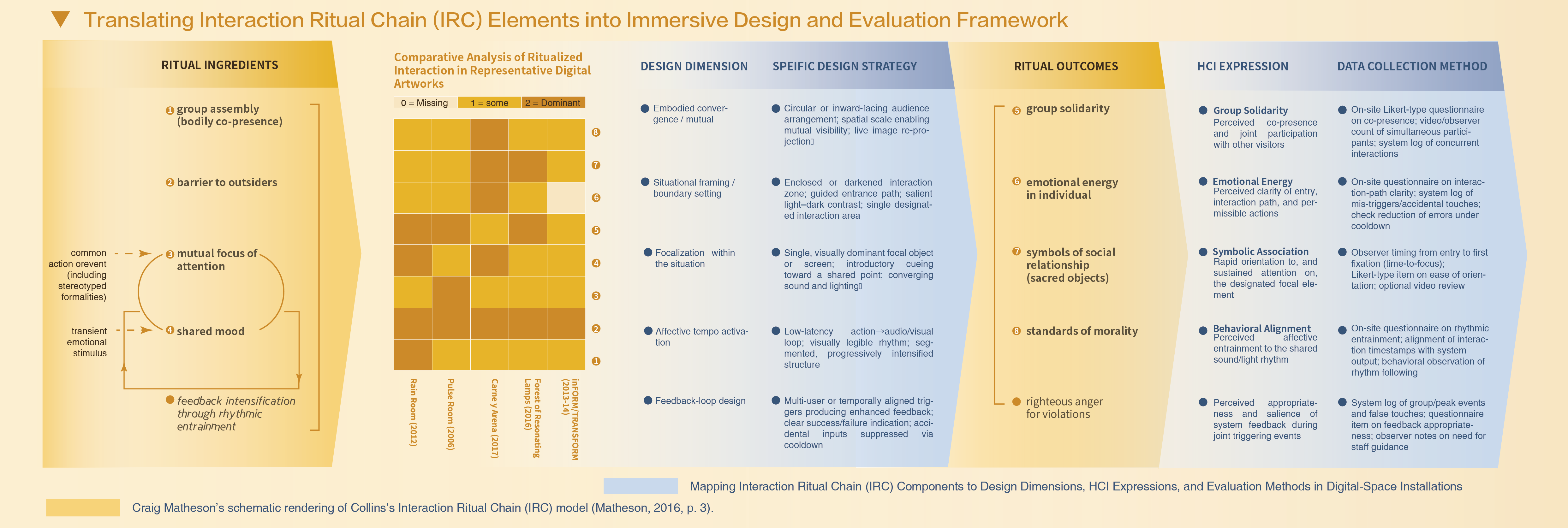
From Collins’s Interaction Ritual Chains to an immersive design framework
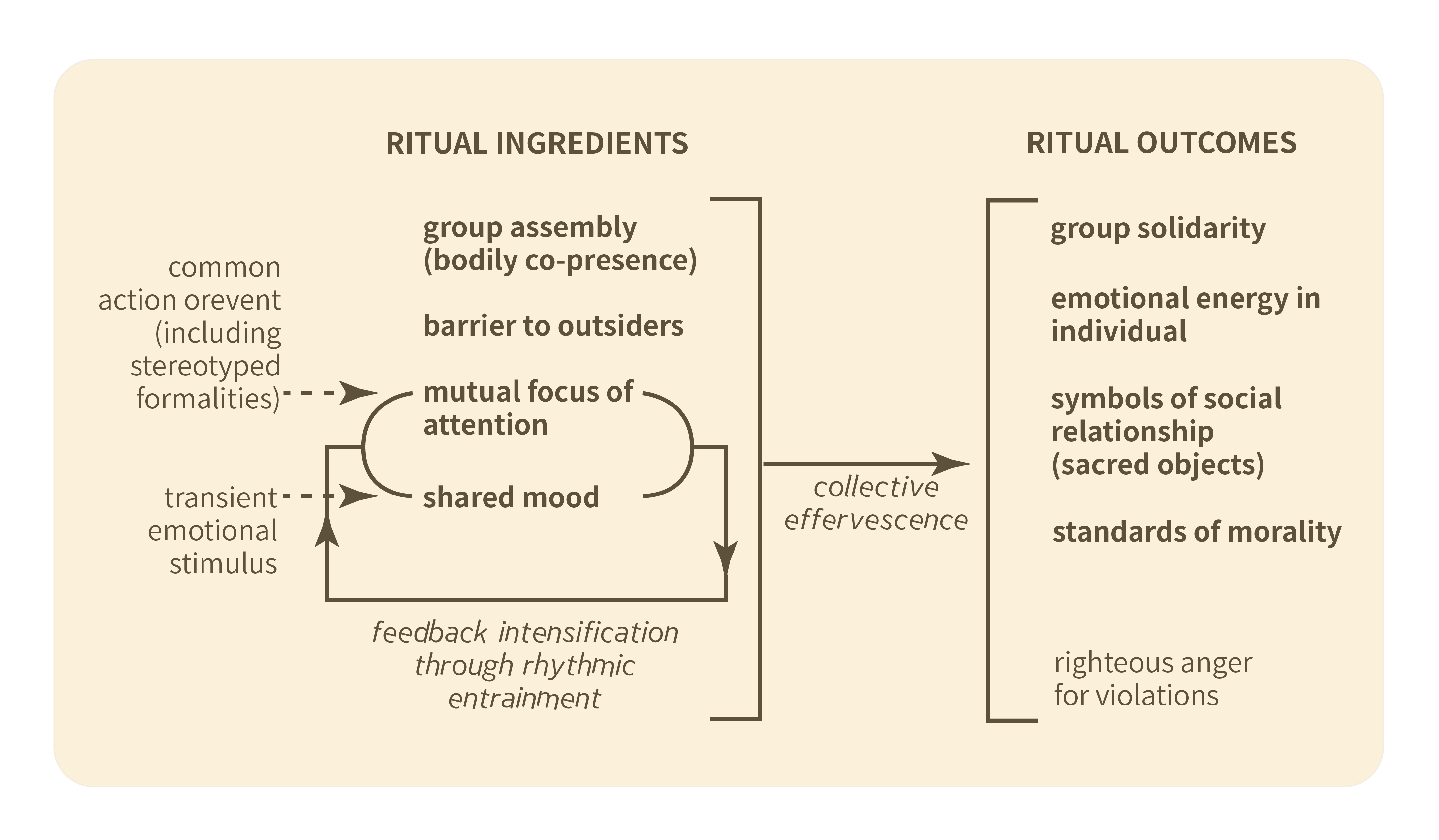
Randall Collins’s Interaction Ritual Chain theory describes four ingredients of a successful ritual: bodily co-presence, a boundary to outsiders, mutual focus of attention, and a shared mood. These conditions can generate solidarity, emotional energy, shared symbols, and common standards. In digitally mediated settings, however, bodily co-presence and sensorimotor coupling are weakened or redistributed, making collective attention and shared feeling harder to sustain.
Resonance treats the smallest perceivable cycle—participant action, system feedback, shared trace, and role shift—as a designable micro-ritual. The theory is translated into concrete spatial, interface, and interaction decisions, then connected to observable HCI indicators and methods of evaluation. The result is a framework that can be applied and tested through practice rather than remaining at the level of metaphor.
04 / Spatial architecture and apparatus
A musical gathering translated into an annular field
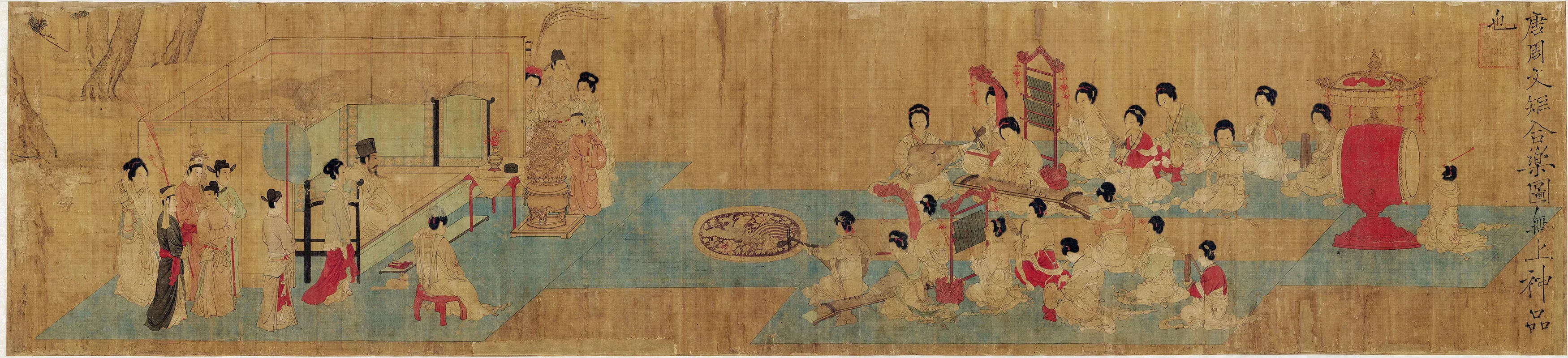
The spatial concept begins with Hele Tu (合乐图), traditionally attributed to Zhou Wenju of the Five Dynasties–Southern Tang period. The handscroll gathers musicians around a shared field of performance, making rhythm, reciprocal attention, and ensemble relations visible. Resonance does not reproduce the painting literally; it translates this cultural structure into an inward-facing arrangement organized around a common center.
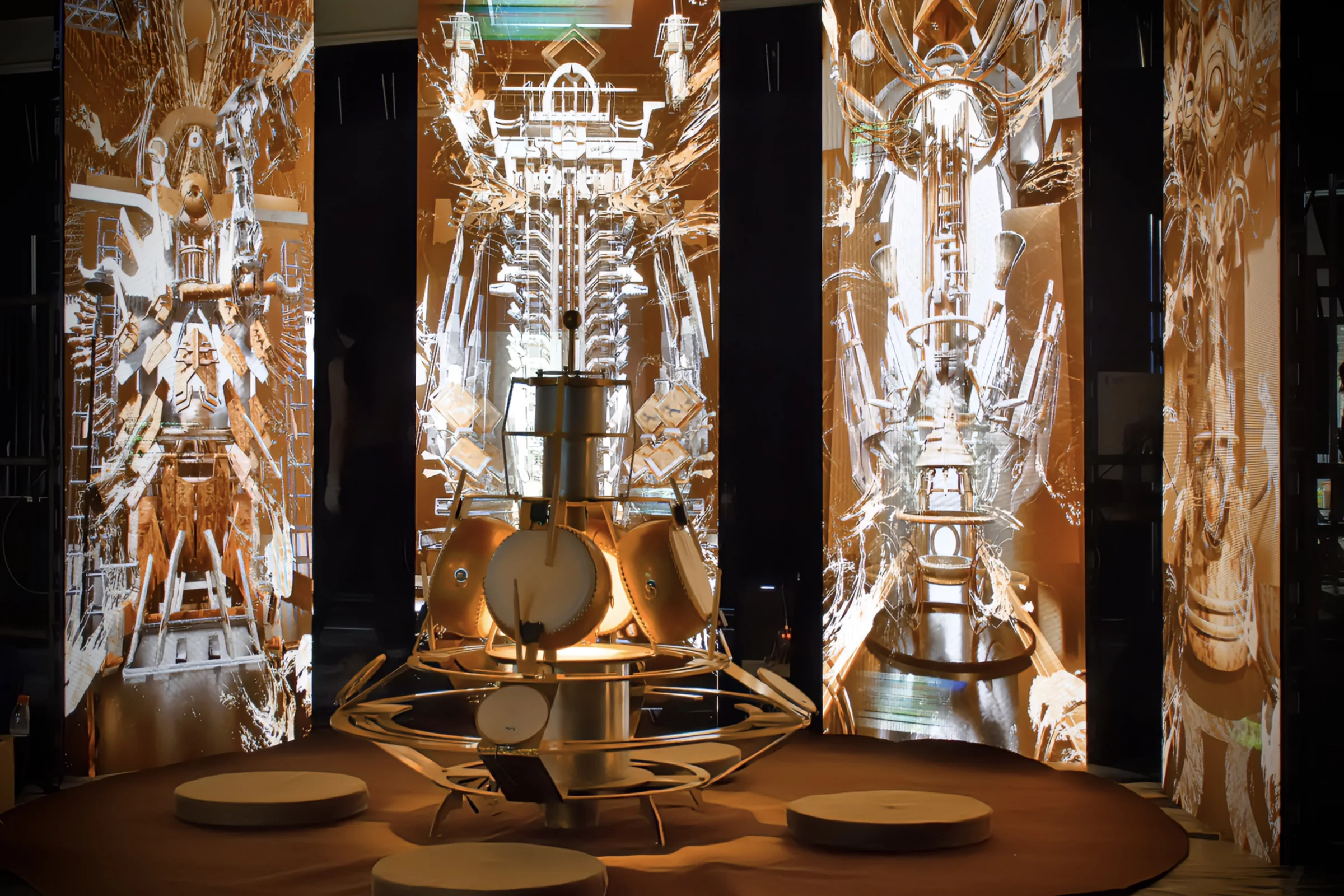
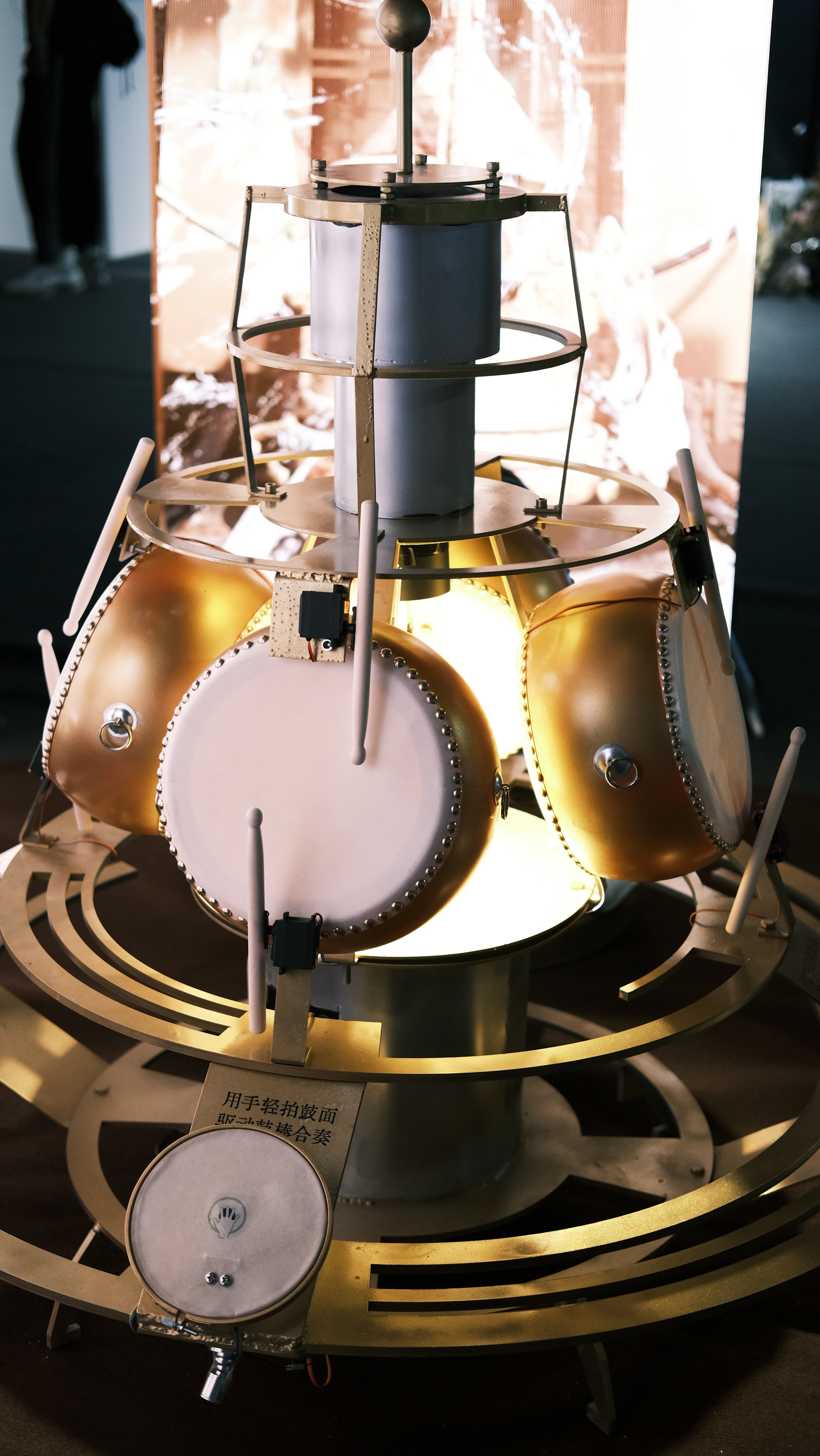
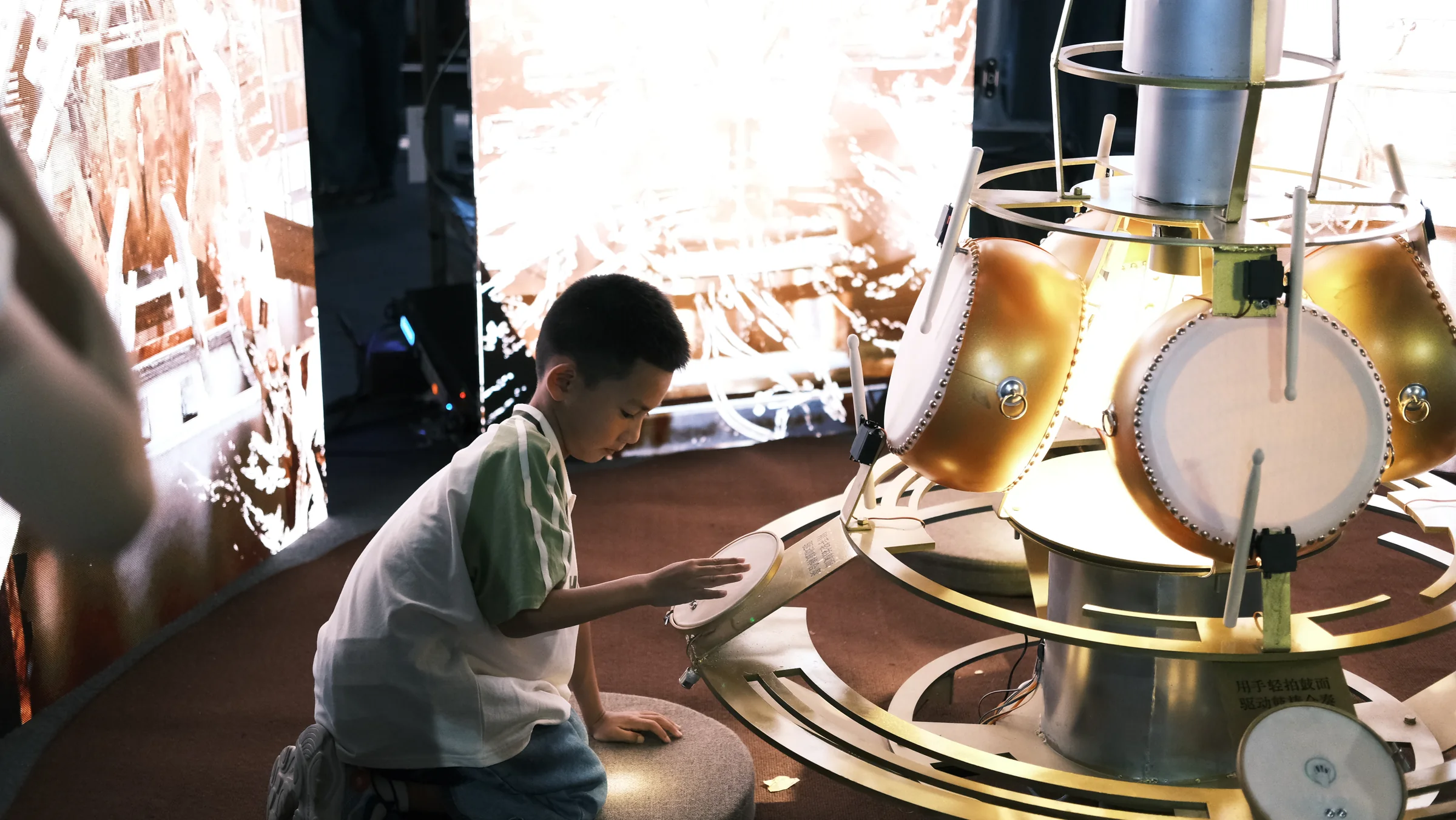
Within a darkened 4 × 2.5 × 3 metre room, a two-tier frame-drum apparatus is encircled by four digital screens. The upper mallets are system-driven and establish the pulse; the lower mallets respond to audience actions, creating a call-and-response between machine and participant. The apparatus also takes the Shanghai Museum’s Coiled-Dragon Frame Drum as a morphological reference, recasting the ritual instrument as a contemporary interactive interface. Live camera mapping places participants inside the surrounding imagery, reinforcing mutual visibility and the transition from spectator to co-performer.
05 / Media integration and technical implementation
One control system coordinates image, rhythm, sensing, and movement
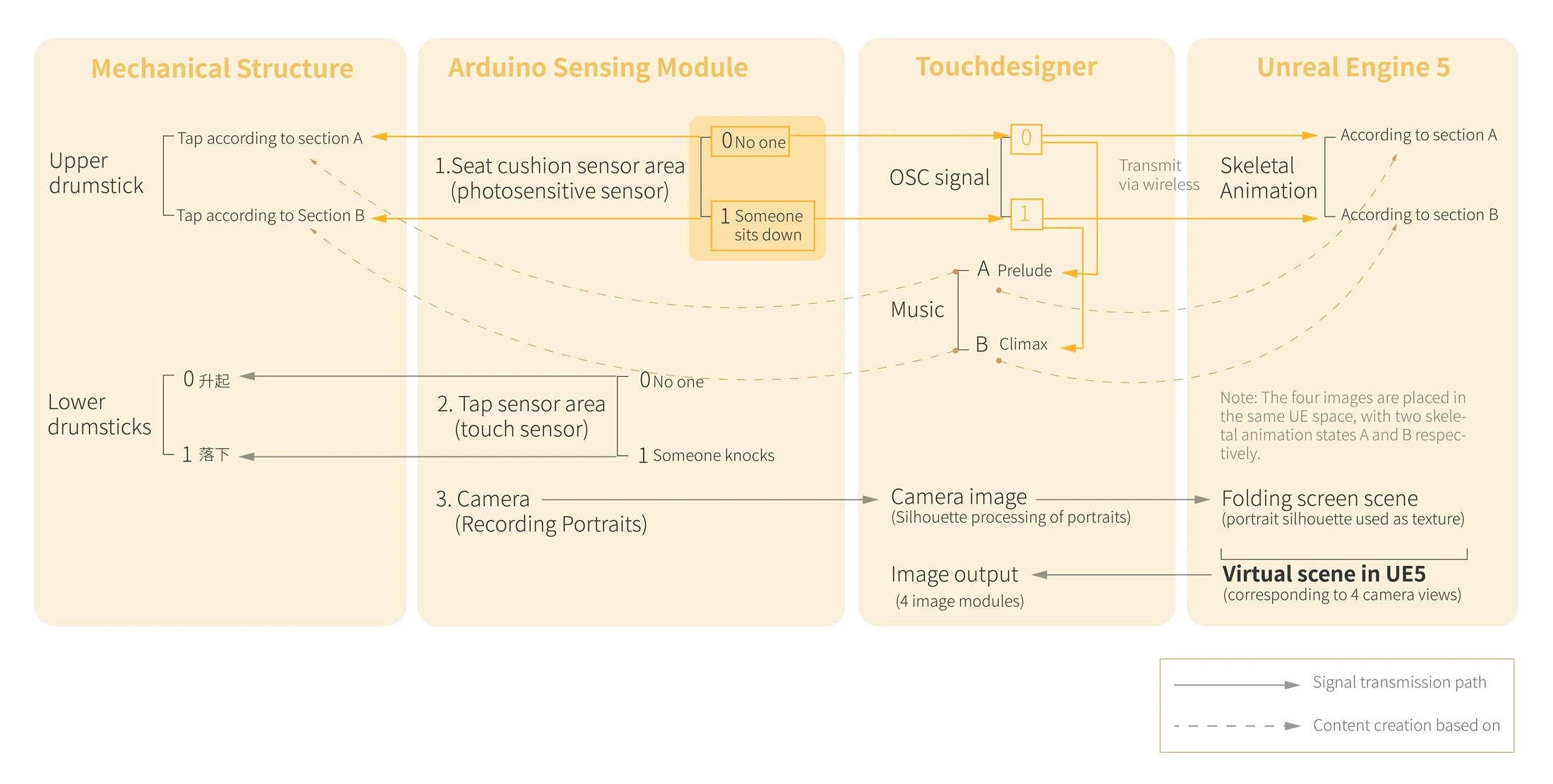
TouchDesigner functions as the central orchestration layer, integrating Unreal Engine 5 visual output with Arduino-based sensing and mechanical actuation. Capacitive touch sensors register strikes, photoresistors detect occupied seats, and a camera captures live images for screen mapping. Servo-driven mallets, multichannel audio, and UE5 sequence changes return immediate audiovisual and kinetic feedback.
The system coordinates waiting, entry, resonance, and closure within a single control graph. Keeping this loop legible and low-latency allows each action to be perceived not as an isolated trigger, but as part of a shared rhythmic structure.
06 / Interaction flow and ritual structure
Four acts move the visitor from observer to co-performer
The experience unfolds as a continuous arc from perception to participation, collective intensification, and release. Each act coordinates spatial cues, sensing logic, tempo, and feedback so that the visitor’s changing role remains perceptible.
-
Act I
Preludial attraction
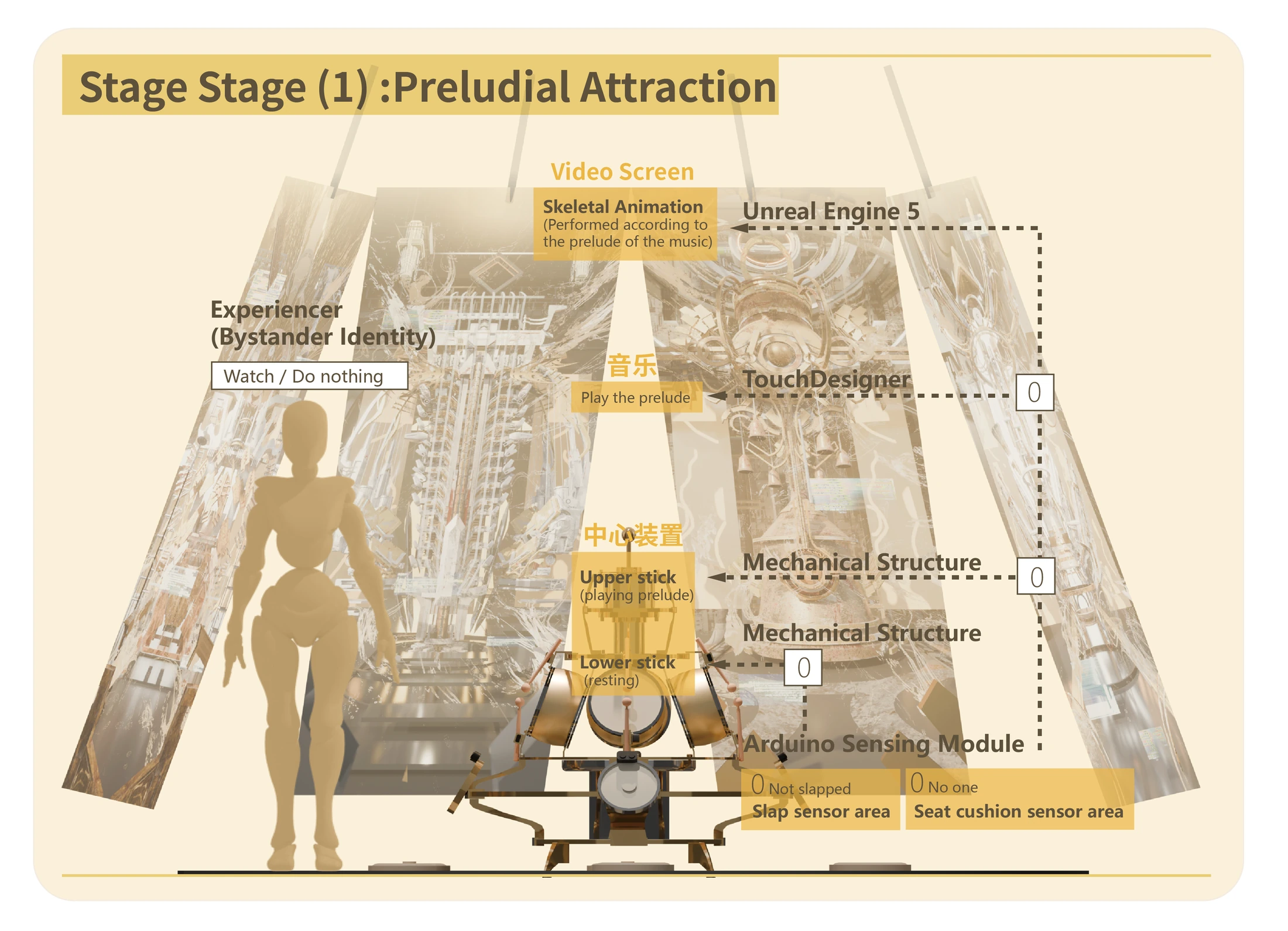
The apparatus leads with a system-driven visual and rhythmic motif, establishing a clear pulse and focal center before the visitor enters.
Act I · Preludial attraction -
Act II
Audience seating and virtual co-presence
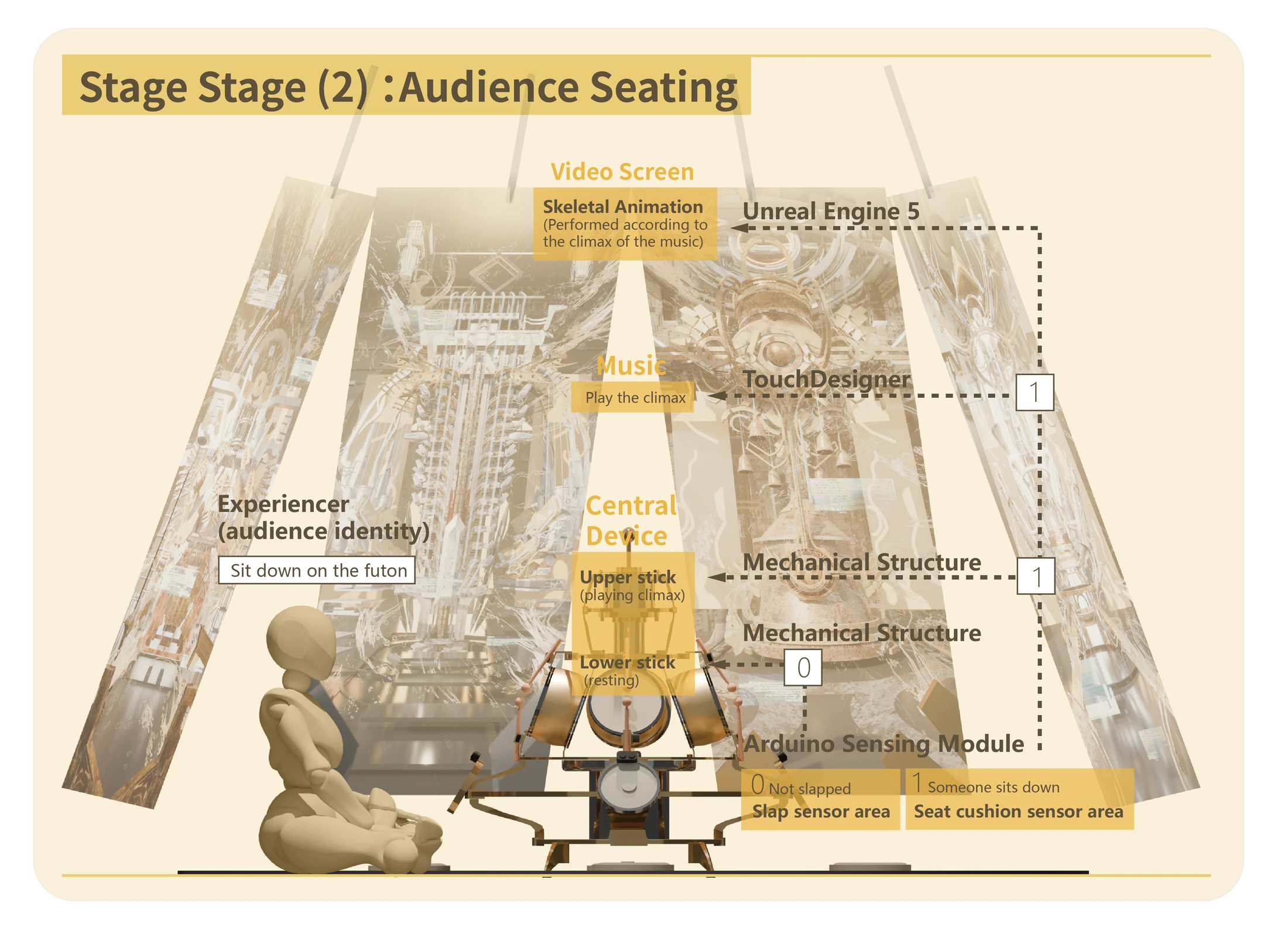
Seat sensing changes the tempo while live camera mapping places the visitor within the surrounding imagery. Crossing the spatial boundary turns a passerby into a participant.
Act II · Audience seating and virtual co-presence -
Act III
Collective resonance
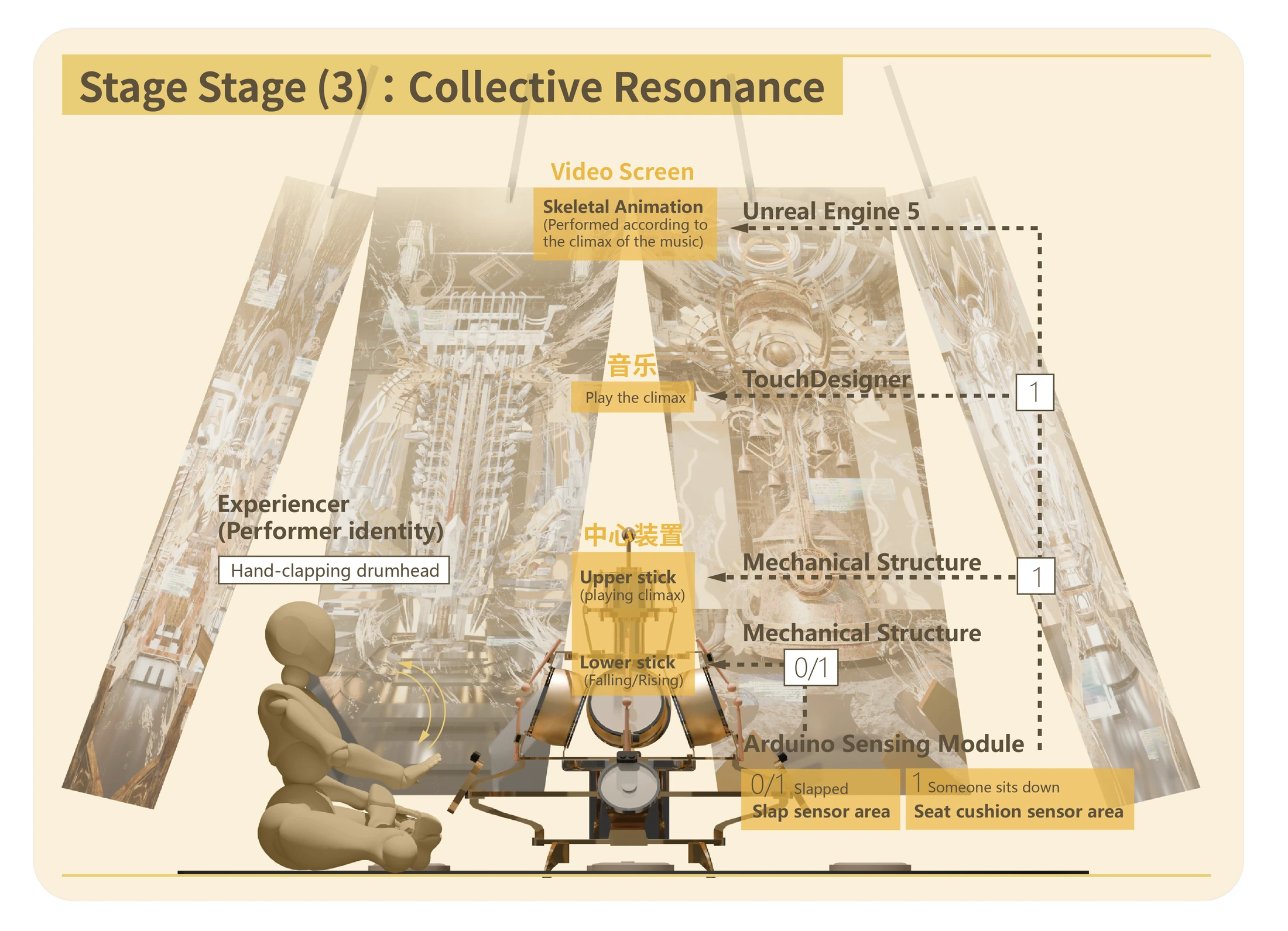
Drum strikes intensify music, image, projection, and mallet movement through low-latency call-and-response. Human and machine now share the performance loop.
Act III · Collective resonance -
Act IV
Ritual closure
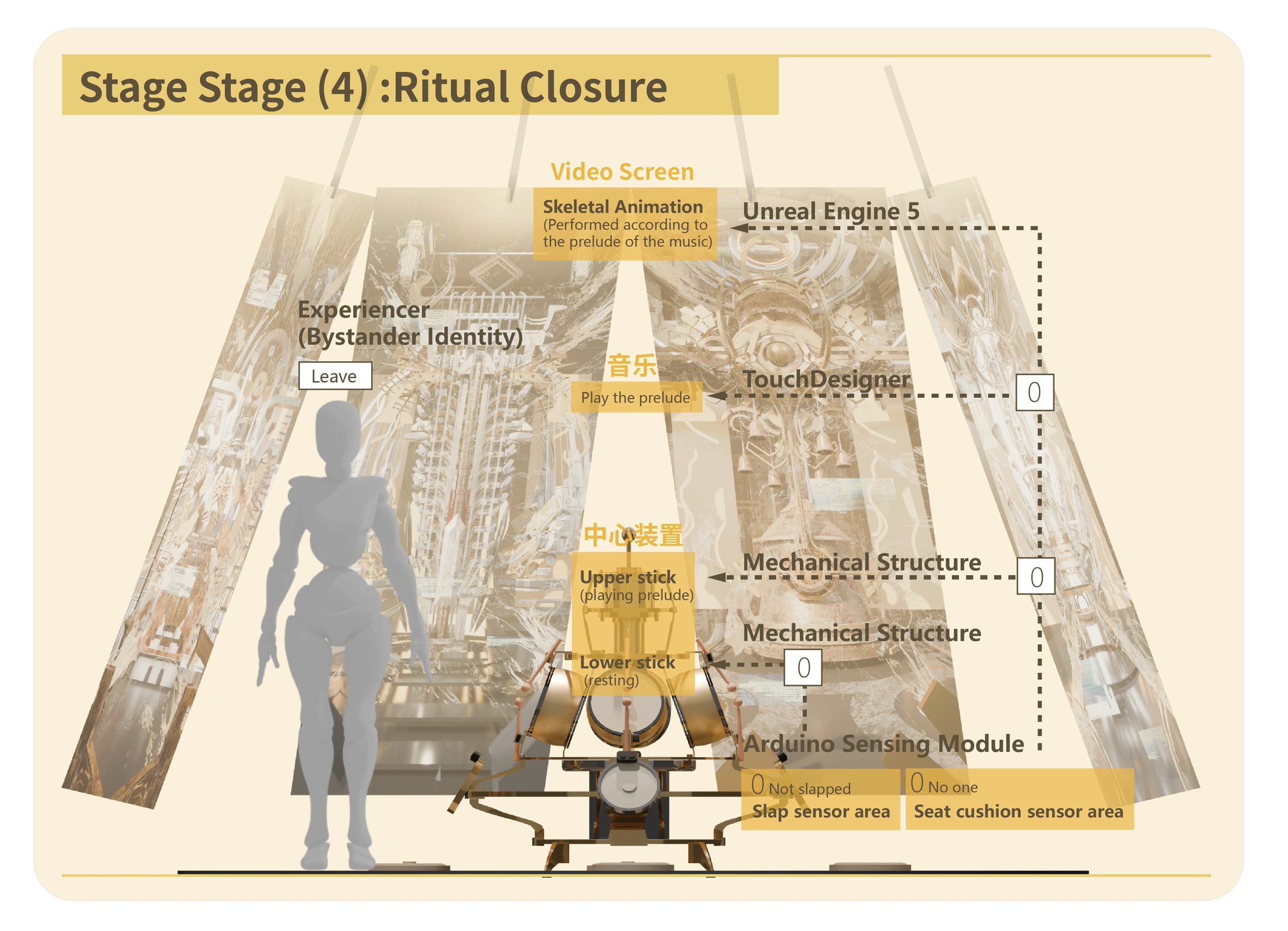
The tempo decrescendos, symbolic traces replay, and the participant leaves the interaction field. The system then returns to its waiting state for the next gathering.
Act IV · Ritual closure
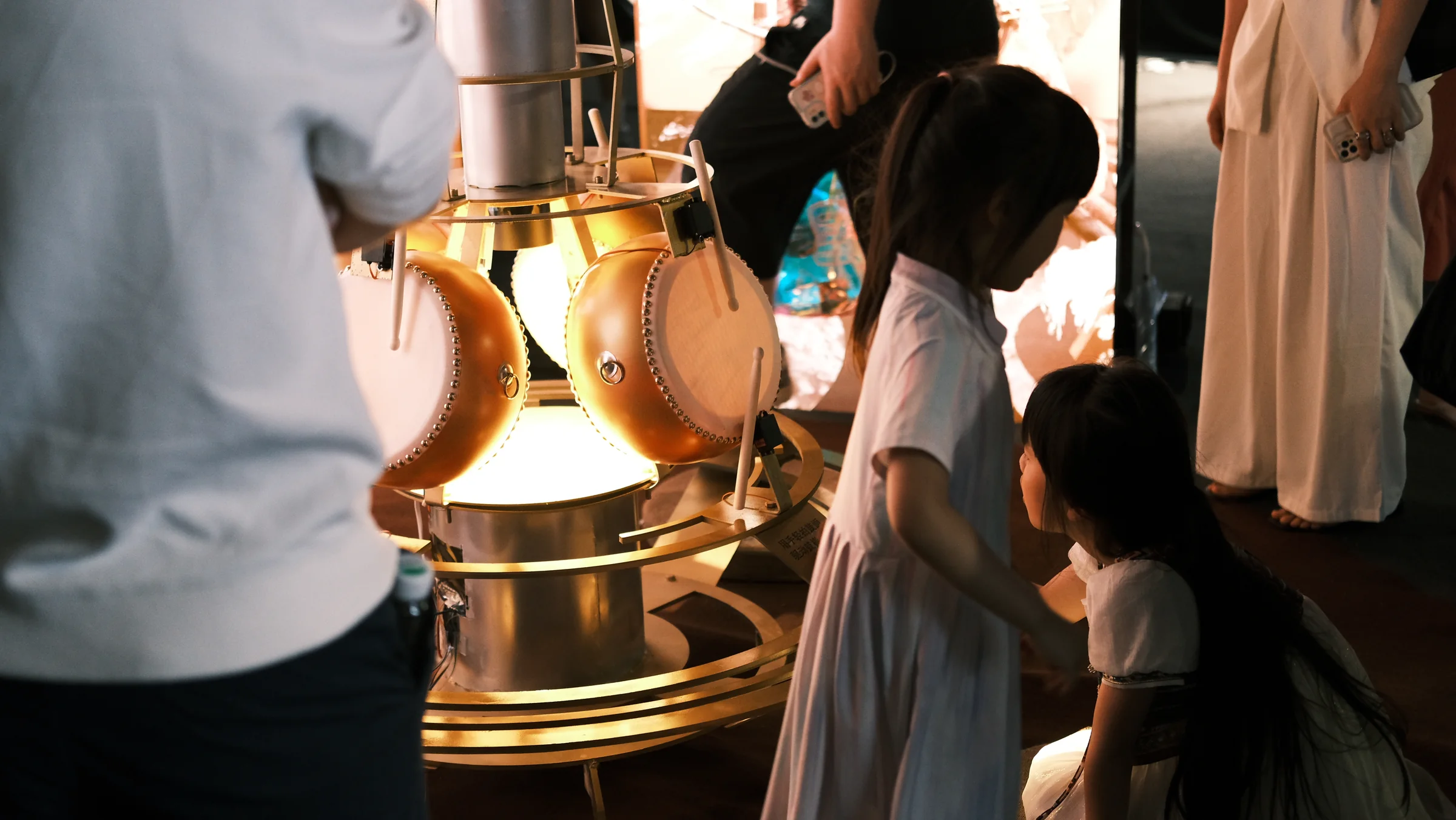
Public encounter
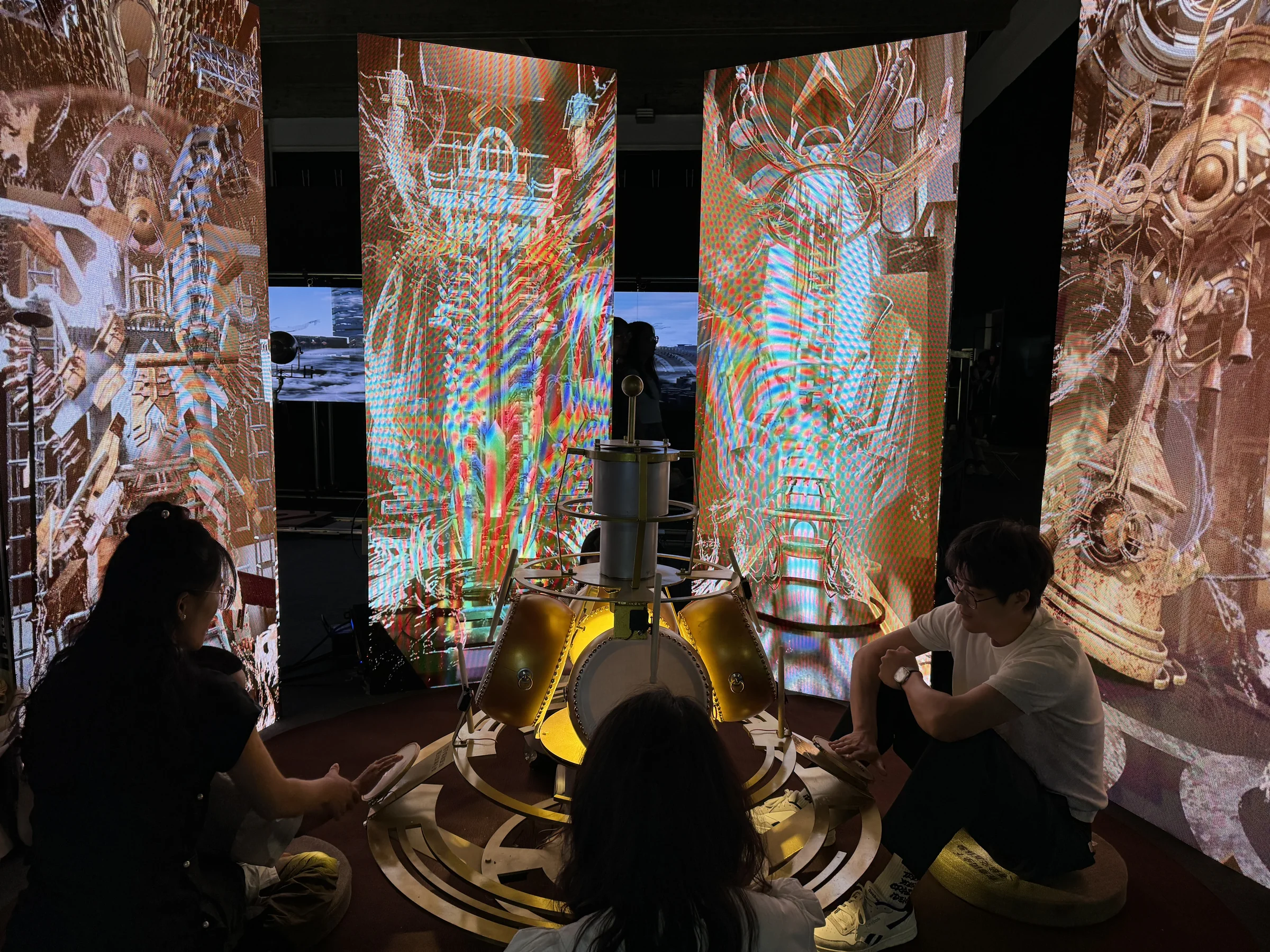
The work becomes a situation shared by its visitors
Research output
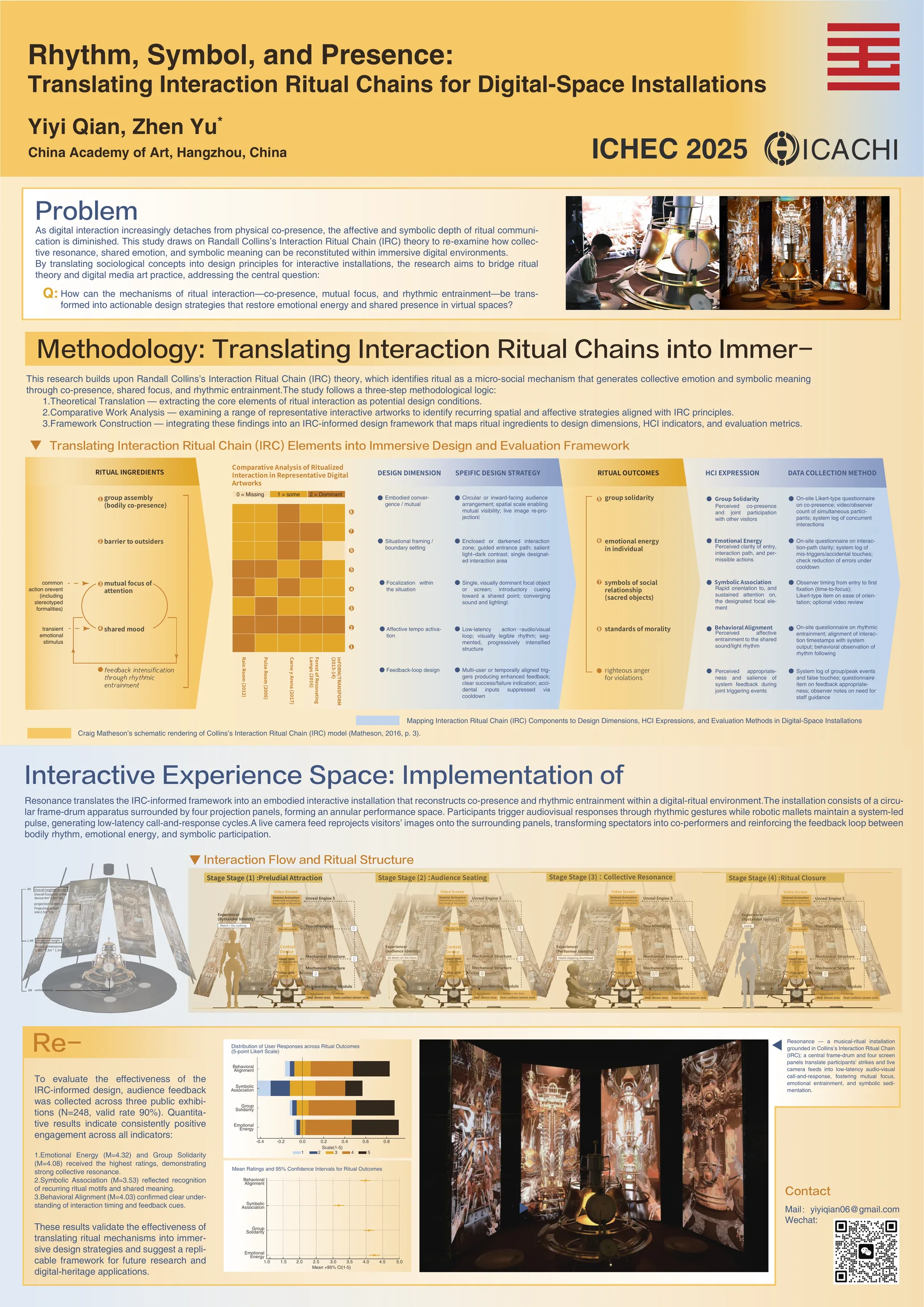
Rhythm, Symbol, and Presence
Translating Interaction Ritual Chains for Digital-Space Installations
Yiyi Qian, Zhen Yu
Proceedings of the 2025 International Conference on Human-Engaged Computing · ACM · pp. 1–11
Project record
Credits and references
Exhibitions
- China Academy of Art Graduation Exhibition, Hangzhou — June 2024
Awards / Selections
- Silver Award, China Academy of Art Graduation Exhibition — 2024
- Best Emerging Talent Award, HONOR Talents Global Design Awards — 2024
Publications
- Qian, Yiyi, and Zhen Yu. Rhythm, Symbol, and Presence: Translating Interaction Ritual Chains for Digital-Space Installations. Proceedings of ICHEC 2025, ACM, pp. 1–11. DOI: 10.1145/3786995.3787041
The team
- Creators
- Yiyi Qian, Ziheng Yu
- Music Production
- Dan Lu, Yuzhou Chen